nikitsina anastasiya
Efficient Airport Terminal Design
The project focuses on creating a terminal layout that enhances passenger movement and optimizes spatial usage to handle a high passenger volume—up to 2,500 individuals at a time. The project aims to blend architectural design with operational logic to improve time efficiency, reduce congestion, and enhance the overall passenger experience within an airport environment.
Project Goal and Context
The core task was to investigate and propose a layout that ensures efficient processing and movement of people through various airport functions. This includes both the "processing area" (check-in, security, border control) and the "piers" (movement toward gates). The proposal considers the increase in air travel, referencing Prague’s Václav Havel Airport’s 2024 traffic data, which reported over 16 million passengers and 134,000 flight operations. Such scale demands a responsive architectural and infrastructural solution.
Understanding Passenger Movement
One of the first steps involved analyzing the movement of people through airports and identifying time-consuming bottlenecks. This helped shape the project's priorities: reducing transit times, distributing crowd flow evenly, and ensuring functional zoning.
Evaluation of Layout Concepts
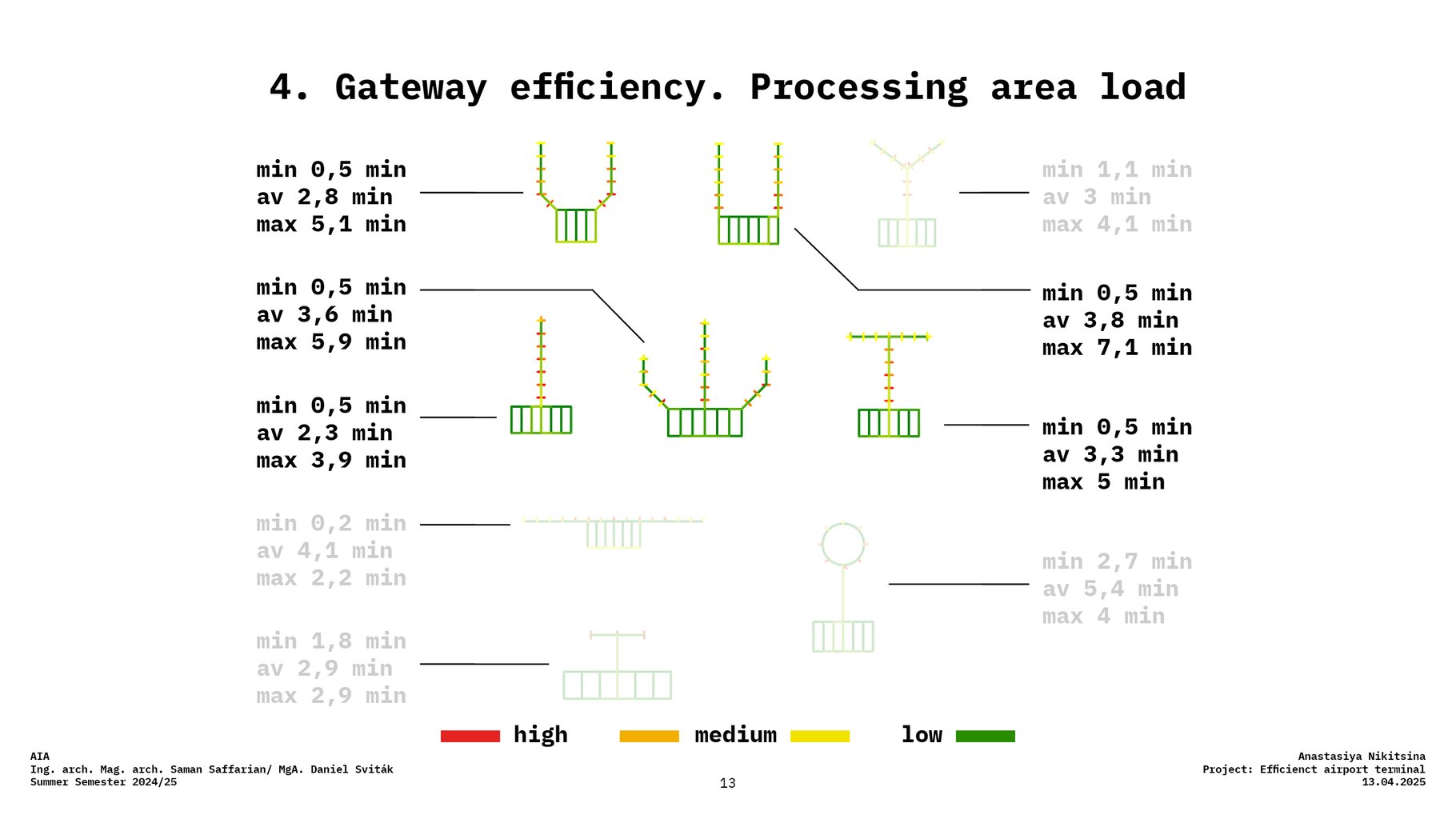
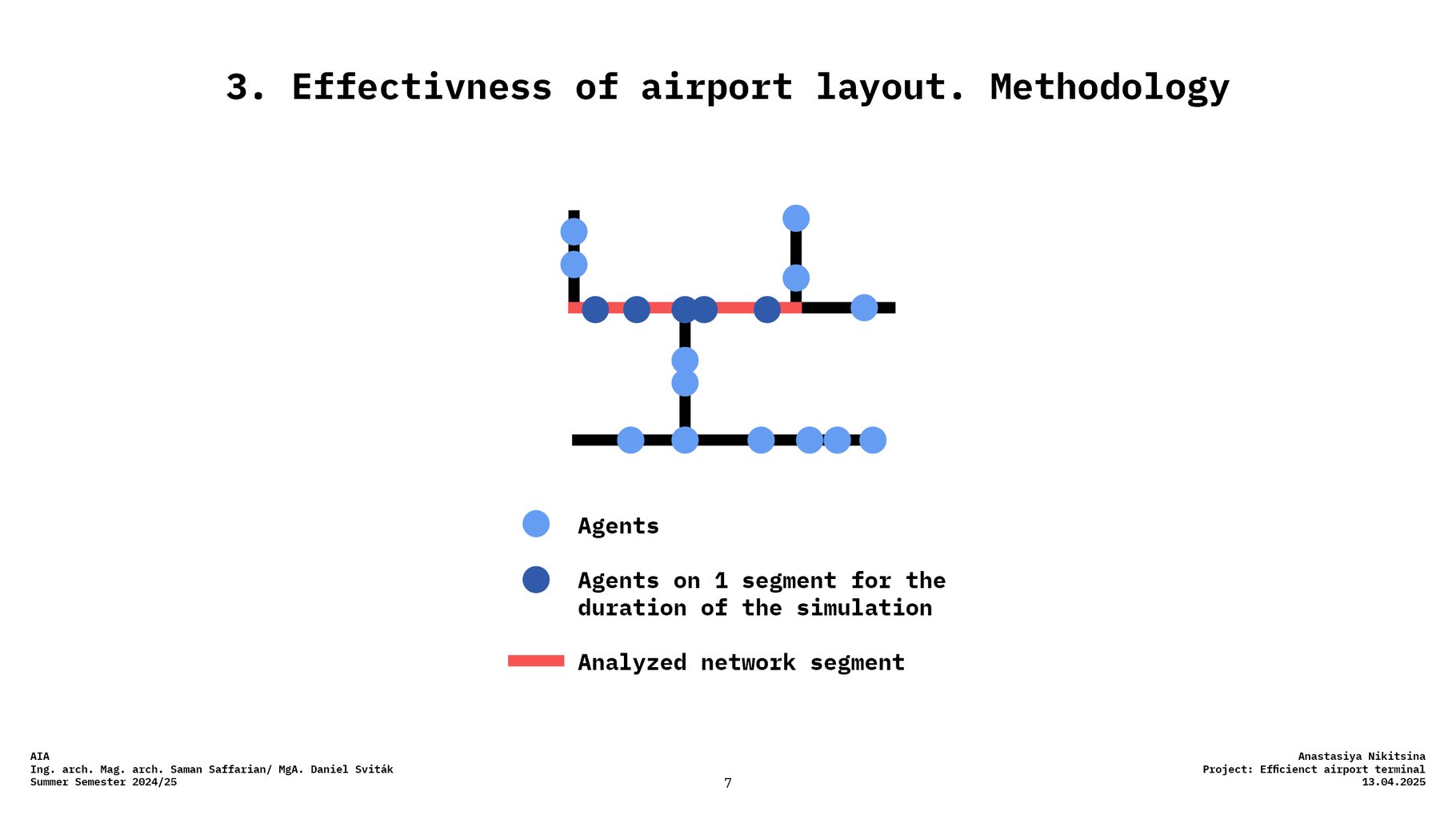
Using Ernst Neufert’s typologies, the project evaluated various layout strategies—linear, pier, satellite, and transporter models. Agent-based simulation tools were used to measure effectiveness through parameters like: time to gate, load on processing areas, passenger distribution, space occupation per user + baggage.
Findings indicated that multi-gate layouts with distributed processing zones offer the best performance in terms of even passenger spread and reduced congestion at peak times. In particular, layouts that separate incoming and outgoing flows and maintain continuous movement show high efficiency.
Layout Optimization & Spatial Calculations
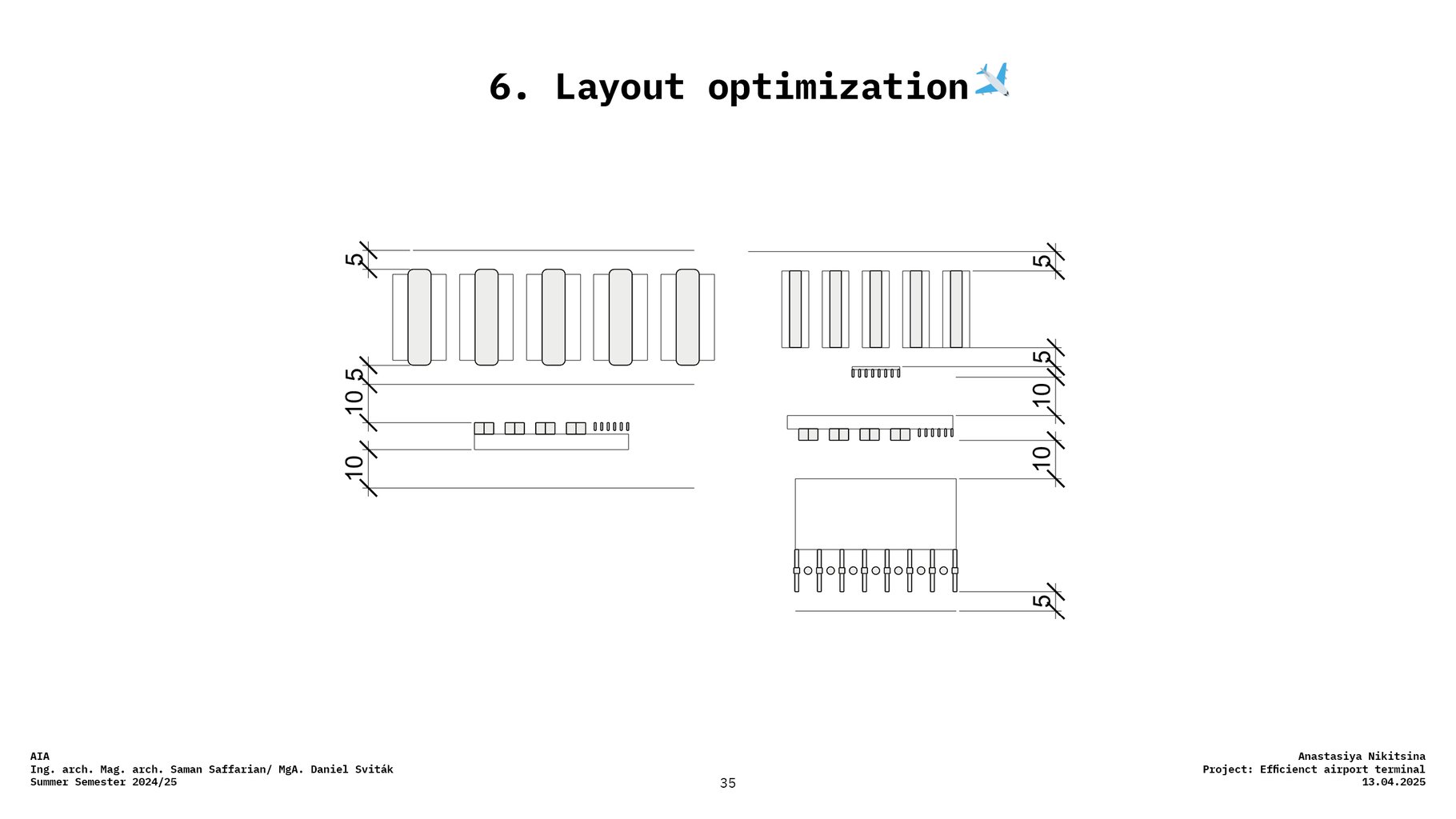
The layout optimization focused on the interaction of people and their baggage with space. Space requirements were calculated using real luggage dimensions (e.g., Ryanair bag policy) and human body footprint assumptions. Different types of baggage combinations were analyzed to estimate the occupied area during each phase of the passenger’s journey.
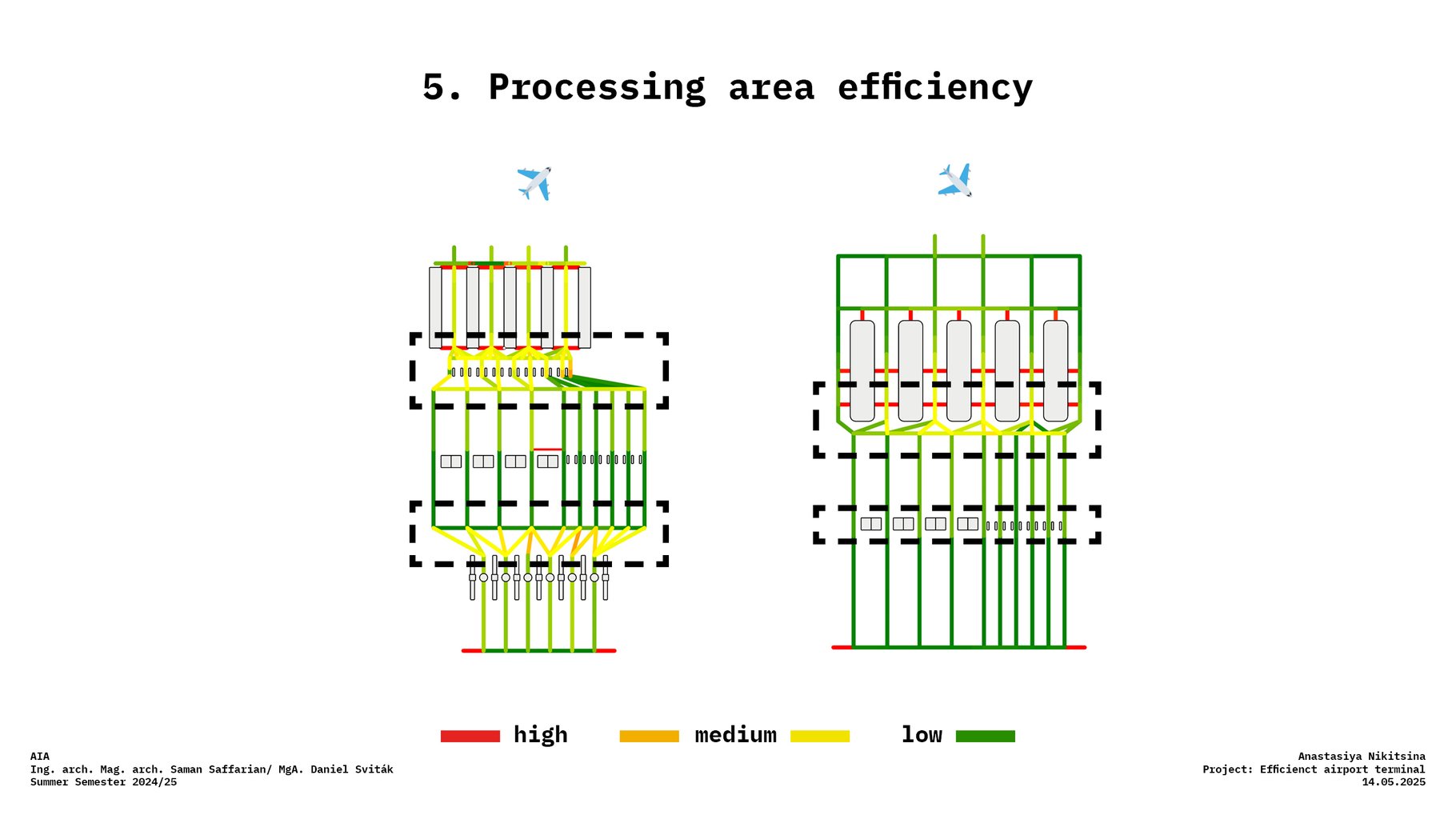
Every zone—check-in, security, gate waiting, baggage claim—was assessed for both time and space usage, using a detailed breakdown of how many people pass through each station and how long they stay there. This led to precise spatial design tuned to actual operational needs, not just theoretical capacity.
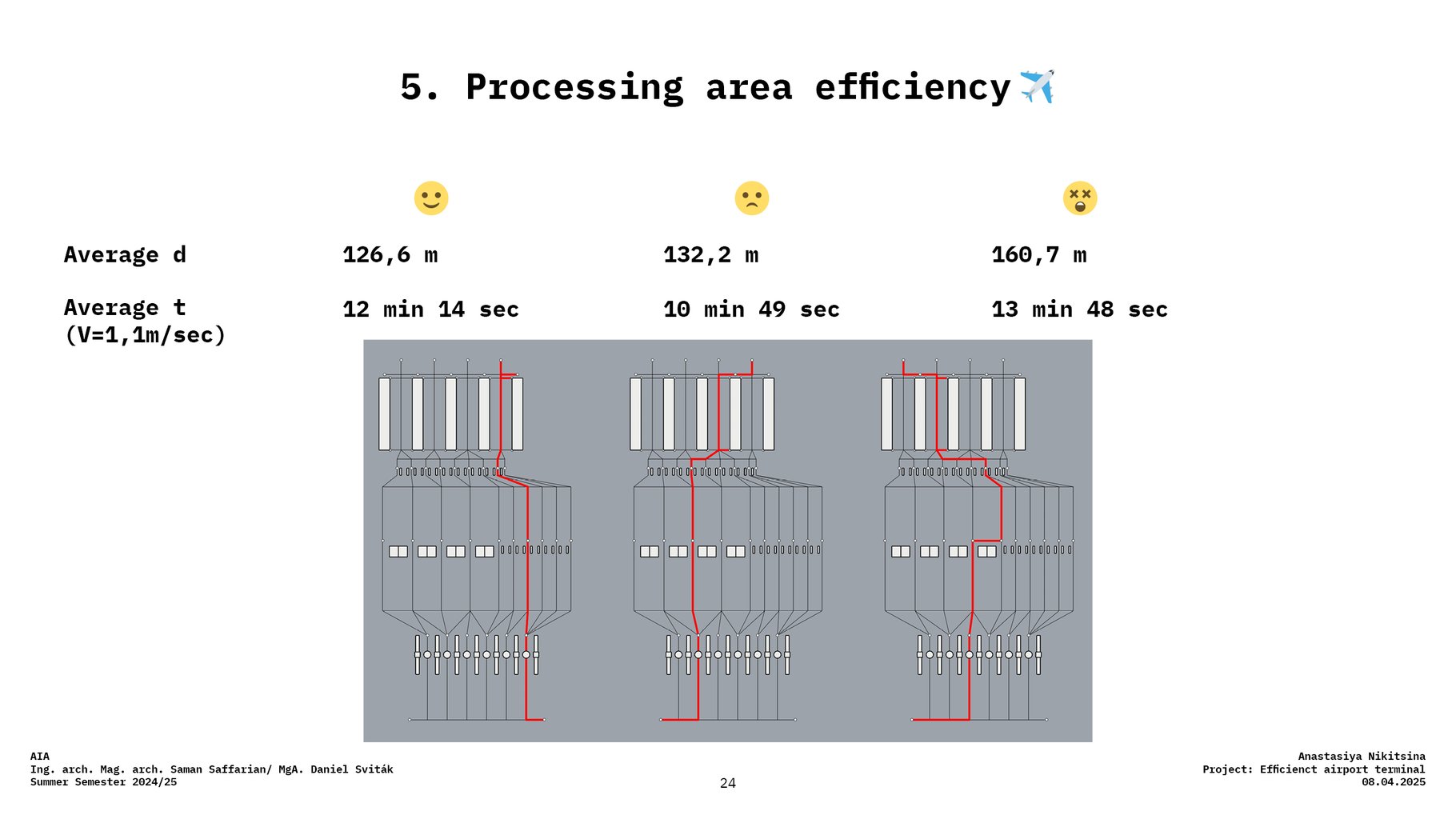
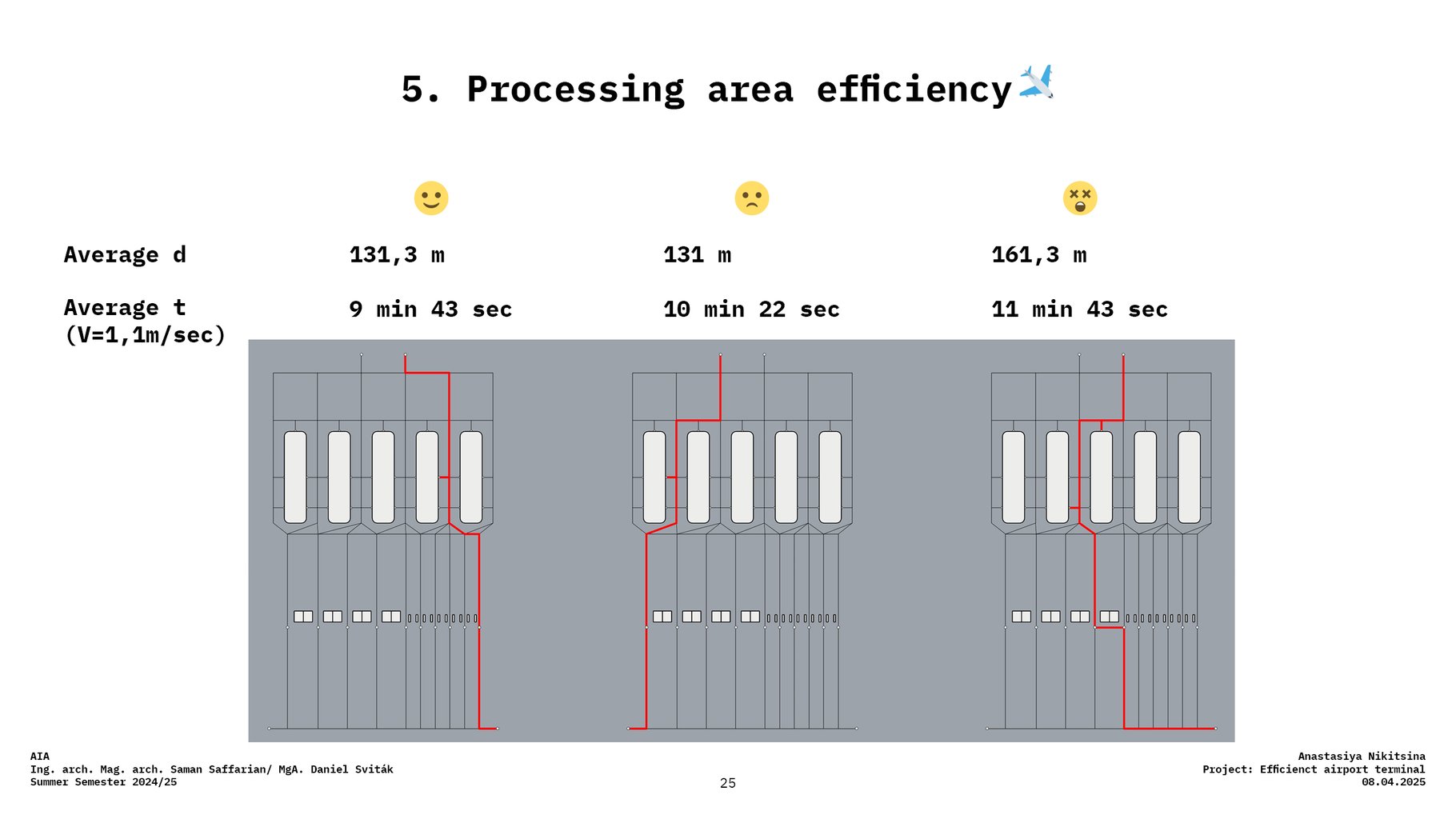
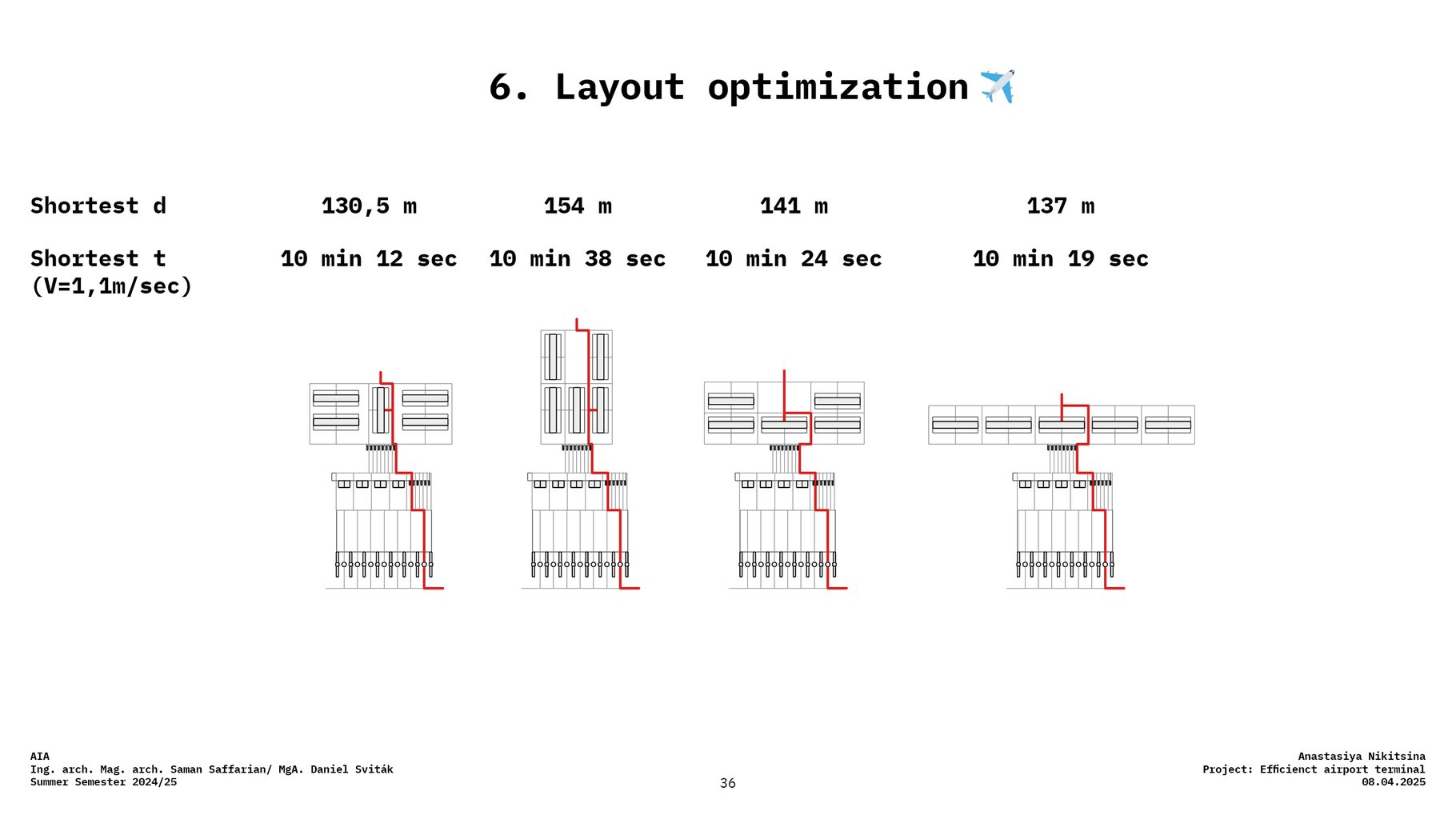
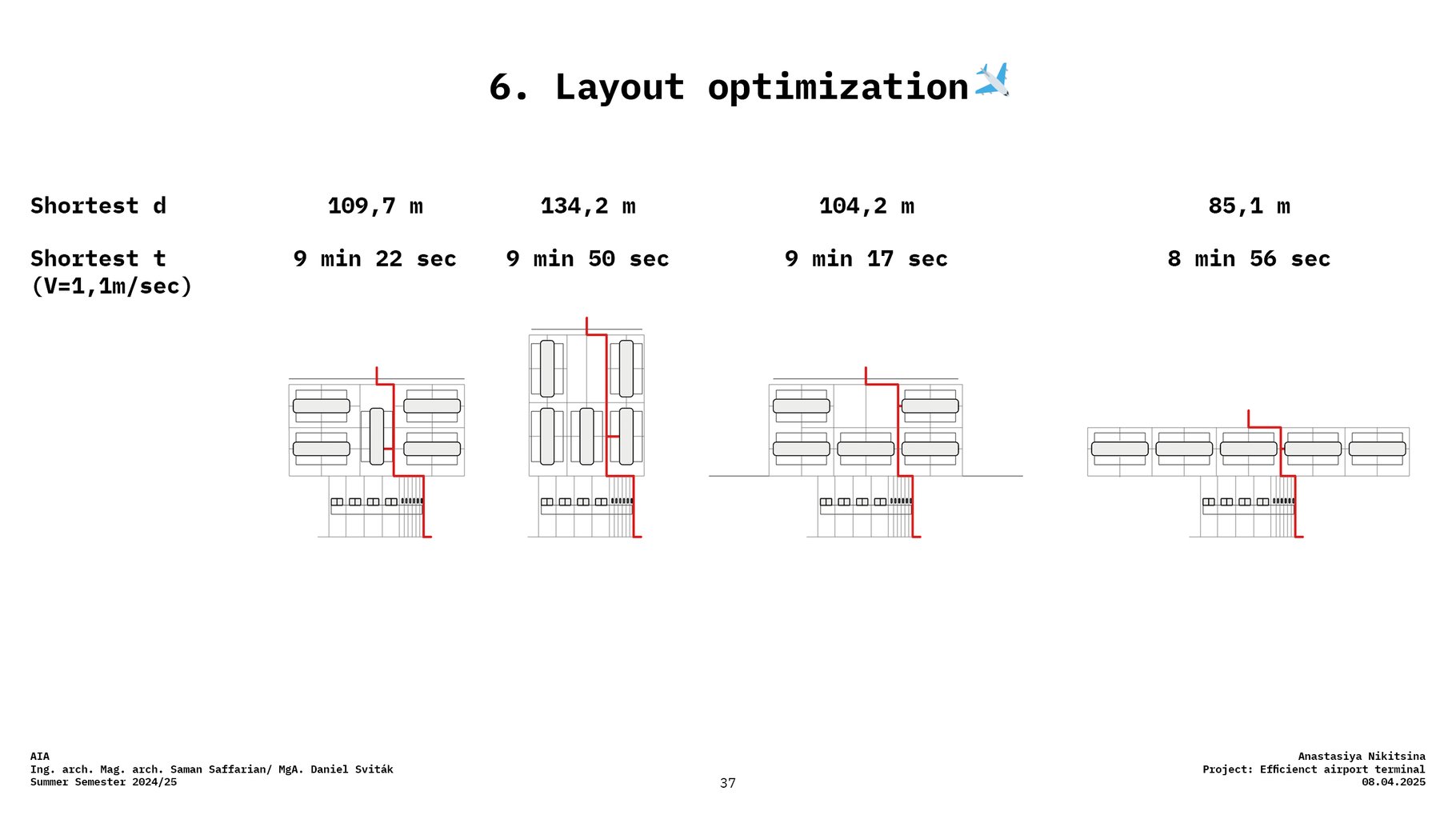
Travel times and walking distances were tested with different layout iterations, ensuring none of the paths caused delays beyond optimal thresholds (~10 minutes). Movement simulations with average human walking speed (1.1 m/s) were used to validate layout efficiency.
Final Outcomes
The conclusions of the project emphasize the importance of processing area design over the linear distance walked. While compactness helps, the real gains come from optimizing: sequencing and positioning of check-in, security, and boarding zones; smooth transitions between zones, avoiding congestion by spreading out the flow from start to gate.
Final layouts propose clearly separated functional zones, continuous corridors with natural crowd dispersion, and flexibility for future adaptation (e.g., modular expansion of gates or processing areas).
ročník 2. Ing. Arch.